Statistics · Reproducible R workflows
Linear models for biological data
How can biological researchers build, diagnose, interpret, and communicate linear models without treating them as black boxes?
Independent coursework from Statistics for Biologists using R at Göttingen. The examples use course-supplied CSVs; their original study provenance and physical units are not fully documented in the public repository.
View GitHub repository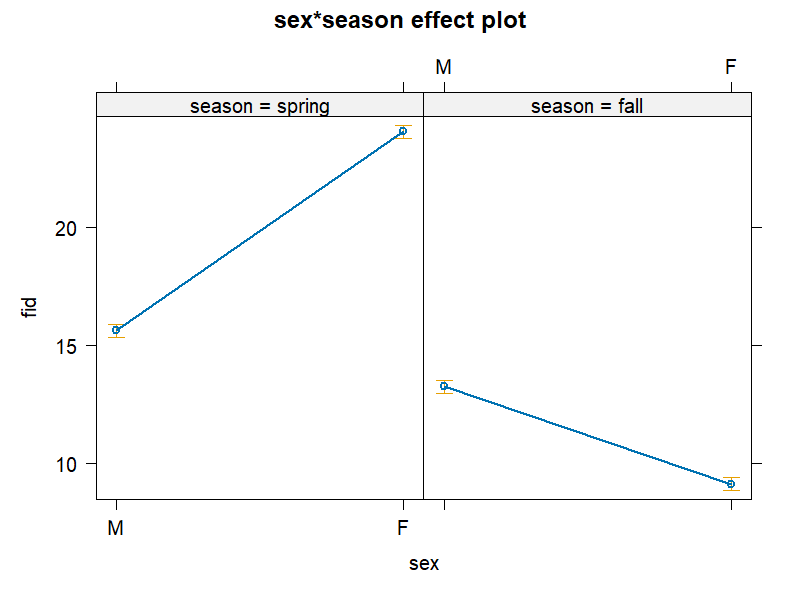 Open full-size figure (opens in a new tab)
The course example fits fid ~ sex * season. Spring and autumn have different modeled sex contrasts. Assess the interaction with model comparison and intervals; the plot alone is insufficient evidence of significance.
I developed a set of readable R workflows that move from model specification to assumption checks and interpretable effect visualizations, emphasizing what coefficients mean in biological contexts.
Independent coursework repository developed from Statistics for Biologists exercises.
- 01Simple and multiple linear regression
- 02Dummy coding for categorical predictors
- 03Interaction modeling
- 04Residual and assumption diagnostics
- 05Effect plots with interval bars
- Reusable worked examples connect statistical notation to R output.
- Diagnostics are integrated into the workflow rather than added as an afterthought.
- Effect plots make interactions and adjusted relationships easier to communicate.
- Course examples do not replace study-specific experimental design; original dataset provenance and units need further documentation.
- Non-parallel effect lines alone do not establish statistical significance. Model comparison, intervals, assumptions, and study design must be considered together.
- These are associational course exercises. The upstream diagnostic code also needs review of signed DFFITS and the distinction between DFBETA and standardized DFBETAS.
- Interaction model and diagnostics (opens in a new tab)
lm(fid ~ sex * season), with male and spring reference levels, confidence intervals, and an additive-model comparison.
- Course dataset (opens in a new tab)
Flight initiation distance with sex and season predictors; no claim of independent data collection.
- Original effect plot (opens in a new tab)
The repository-generated figure shown here, rather than an illustrative reconstruction.